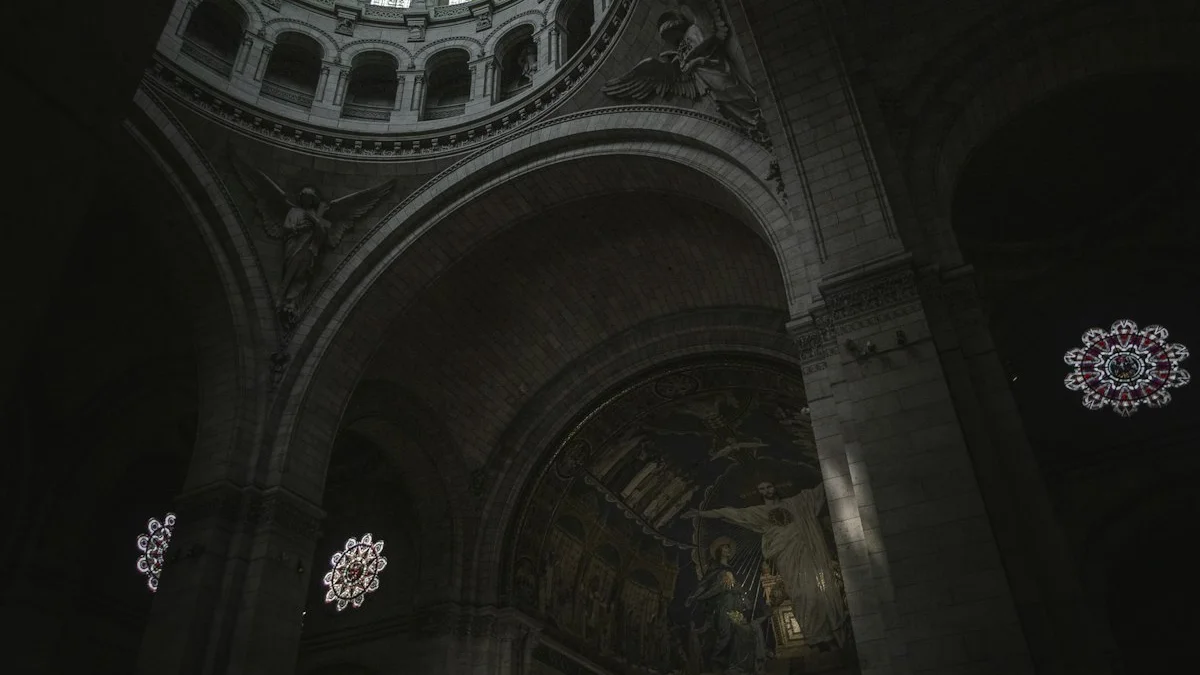
Every origin in the Obsidian Key begins with a job, not a vision. A nineteen-year-old signs a ledger, takes a borrowed key, and walks into the Halloway House expecting weeks of quiet inventory. Instead he walks into the front door of the entire story, and the first night is where the book hides its most important rule in plain sight. This page walks that night in order, scene by scene, the way the narrator tells it. It belongs to the lore guide to the Obsidian Folios, which keeps the full chronology in one place.
Key takeaways
- Night one is a job like any other job, and that ordinariness is what makes it dangerous.
- The instruction sheet says two things: catalogue, do not read.
- The narrator remembers no fear that first night, and the absence of fear is the point.
- Observation is tested before appetite: objects are listed without being unwrapped.
- The unmarked crate waits until the fourth week, and the waiting is part of the design.
The Halloway House stands back from its road
The scene opens the way a hundred ordinary custodial jobs open. The narrator fixes the frame in one line:
“I was nineteen when I took the night shift cataloguing the Halloway Collection.”
He asks to have the episode told in order, because the order is the lesson. Nothing about any single evening felt remarkable. The unusual gets into a life quietly, on ordinary evenings, through doors that look like work.
The house itself is introduced through distance and shade.
“The house stood back from its road behind a gravel drive, behind trees that kept it in half-dark even under a full moon.”
The employer’s part is brief. A dead collector’s estate needed cataloguing, the pay was poor, and the hours were nights, because the executor wanted it that way, offering no explanation beyond the remark that the house sat better that way. That unexplained preference is the first warning the reader receives. Then the key.
“The key was under a stone, exactly where I was told it would be, and I remember thinking that a man who hides keys under stones has already told you what kind of house this is.”
A key under a stone is trust with no ceremony attached. Whoever arranged the job already knows who he is hiring, and the reader later learns how early the arrangement actually began.
The instruction that ran the house
Inside, the atmosphere is inventory and memory at once. Dust, paper, and pipe smoke soaked so deep into the shelves that the rooms seemed to remember the dead man. A green-shaded lamp over the work table. On that table, an instruction sheet in a neat, cold hand, consisting of a single line of two verbs:
“It said two things. Catalogue. Do not read.”
Every rule of the apprenticeship is compressed into those four words. Catalogue is the whole employment: hours logged in a ledger, crates of books, boxes of papers, wrapped objects listed without being unwrapped. Do not read is the single prohibition, unsigned and unexplained. The sheet never argues and never threatens. It assumes obedience and moves on, and the test is whether the rule holds when nobody is watching.
The work of the first night
The night itself is uneventful by design. He logs his hours and works the stacks while the building makes its noises around him.
“The house made sounds all night, the ordinary sounds of any old structure”
and he catalogues through all of them, for the whole of that first night, without reading a single book. The sentence does quiet double duty. It says the first night passed clean, and it says the condition of the test was already in force: complete access to the collection, one line of prohibition, and an employee alone in the dark with both.
Then the narrator turns to the reader and says what makes night one worth its own chapter.
“I want to be honest about the fear. There was none. That frightened me later, when I understood what should have been there.”
No fear that night. The fright arrives later, in retrospect, when he can compute what the stillness of the house was actually for. On the night itself there is only a lamp, a ledger, and a man doing honest work badly paid.
Why the absence of fear matters
The lore of the Order repeatedly selects for observation and honesty rather than for courage, and night one is the first reading taken. The narrator follows the sheet exactly even when it explains nothing. He catalogs wrapped objects without unwrapping them, which means he can tolerate an inventory that includes things he will never see. When the Order later tests him with a night of copying, the men who failed were the ones who lied fastest, and night one measured the same trait: whether a man reports what happened or a more comfortable version of it.
The scene also sets the texture of everything after it. The Order’s world is not gothic. It is clerical: keys under stones, green lampshades, ledgers, weekly reports to an address. The dread, when it finally comes, comes from bureaucracy behaving strangely, not from anything theatrical.
What the first night set up
For three weeks the work stays ordinary, and the reports go out weekly to an address he had been given. The fuller anatomy of the library, its rooms and its logic, is gathered in the companion piece on the Halloway Collection, which treats the library as a character.
In the fourth week, in the cellar stacks, the design of the first nights becomes visible. A crate that is not on any inventory. Unlabeled. Older than the others, the wood gone gray, the nails holding by habit rather than grip. He opens it because an unlabeled crate is a defect in a catalogue, and inside is the collection’s real cargo.
“Inside, wrapped in oilcloth and tied with waxed twine, were folios. Hand-copied, stitched at the spine, their covers dark and dense like cooled tar.”
Dozens of volumes, in hands that change from volume to volume, different centuries of the same discipline written as instruction. He catalogues them precisely and does not read them that night, and the book notes that this precision mattered more than he could easily convey. The manuscripts get their own page in the explainer on the Obsidian Folios, including why the chapter epigraphs come from them.
Night one, in other words, is not the night the story starts. It is the night the narrator is measured. What the measuring admitted him to is carried forward in the piece on the keeper of the outer folios, while the doors that stayed closed even to him are gathered in the page on the doors of the archive.
Frequently asked questions
Is the Halloway House a real place
The book keeps the question outside its frame. The narrator writes as a memoirist and gives the house an address only in details: a gravel drive, cellar stacks, a work table under a green lamp. The setting behaves like a real place with rules, while the text never asks the reader to verify anything.
Why did the instruction say do not read
The surface reason is custody: a cataloguer handles, sorts, and records, and a reader does something else entirely. The deeper reason arrives later in the book, when the narrator learns what access does to someone unprepared for it. The two-line sheet is also a filter, since people who cannot obey an unexplained instruction remove themselves early and quietly.
Did the narrator break the rule on the first night
No. He catalogues for the whole of the first night and does not read a single book. The breach comes later, after the crate in the fourth week, on a night when he is alone and breaks the rule deliberately. The separation matters, because the first night establishes what he was before the reading.
Where does night one sit in the story’s chronology
It is the opening movement. Nineteen at the first night, twenty when the Order closes behind him, thirty-five when it opens again to put him out, and decades after that when the First Breach Edition appears. The house is the first station, the crate the second, the interview the third, and the copying test the gate. Everything the doctrine later teaches is framed by that building catalogued by night.
The door the first night opened
Night one gives the reader the whole method of the story in miniature: an ordinary job, an unexplained rule, a man who keeps it, and a house that notices. The rest of the account, the crate, the one page, the induction, and the price of all three, is told in The Obsidian Key.
This guide is educational and spiritual in nature. It is not medical, legal, or financial advice. If a practice brings up distress, speak with a qualified professional.