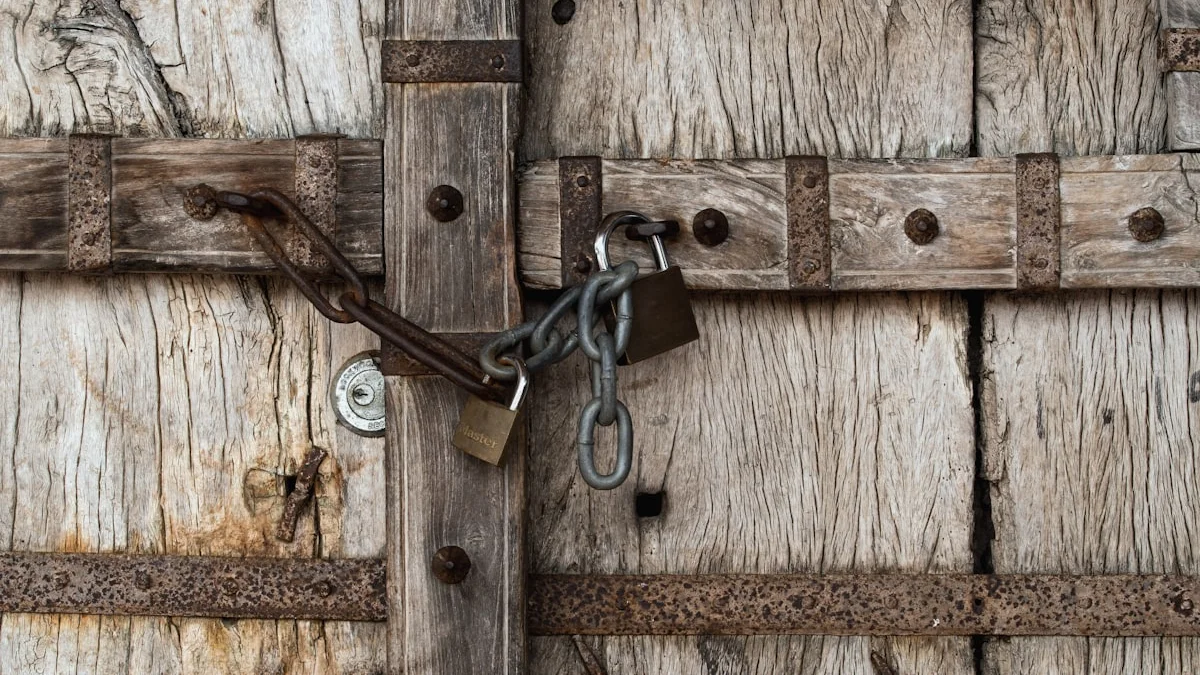
Nineteen years old, night shift, a house set back from its road behind trees that kept it in half-dark: that is where the narrator of The Obsidian Key begins, cataloguing a dead collector’s library. The key waited under a stone. The instruction sheet said two things, catalogue and do not read, and the second clause turned out to be the whole career. Because the library was never one room. It was stacks and cellars, and somewhere below the catalogued shelves stood the folio archive doors that stayed closed to him through fifteen years of service, doors he was never cleared to open and, by his own account, remained glad of. This page is a lore walkthrough of what stayed shut, who held the keys, and why a book about unlocking anything begins inside locked rooms. The full story is gathered in the Obsidian Folios lore guide.
Key takeaways
- The narrator guarded the shallowest layer of the archive; its depths stayed closed to him for his whole service.
- The Obsidian Folios arrived hand-copied and stitched at the spine, their covers dark and dense like cooled tar.
- The Order was a library, not a throne: it copied, memorized, verified, and released nothing.
- Limited access was the discipline, not the insult, because access without alignment is a curse.
- The First Breach Edition is the one door that opened, a complete manual at the cost of a paperback.
The folio archive doors in the Halloway House
The house itself, the Halloway Collection, was the visible layer: a private occult library left behind by a dead collector, dusty enough to smell of pipe smoke soaked into the shelves. Four weeks into the job, in the cellar, the narrator found an unlabeled crate older than everything around it and opened it, since an unlabeled crate is a defect in any catalogue. The scene of that discovery, and the library around it, is walked through in the Halloway Collection.
“Inside, wrapped in oilcloth and tied with waxed twine, were folios. Hand-copied, stitched at the spine, their covers dark and dense like cooled tar.”
That crate was the outer edge of the archive, the only layer the night shift was ever meant to touch. His formal title came later, and it is the most precise sentence the book offers about the architecture of access.
“Fifteen years, and my title, keeper of the outer folios, meant I guarded the shallowest layer of an archive whose depths I was never cleared to see.”
Read the sentence as a floor plan. An archive with a shallowest layer implies deeper layers, and deeper layers imply doors, and doors imply someone who decides. What the keeper guarded, and what the title actually cost him, is its own page in keeper of the outer folios.
What the shallow layer held, and what it did to its copyists
The outer folios were manuscripts in the strict sense: copied by hand, volume after volume, in changing handwriting across centuries of the same discipline. The Order transcribed, memorized, tested, and waited.
“For fifteen years I transcribed, memorized, and tested the material on myself, and rose to keeper of the outer folios.”
The copying itself was the mechanism. The book’s claim is that the act of copying slowly tunes the copyist, the way a musician is tuned by scales, which is why the Order refused every shortcut that speed would have offered. A page copied letter by letter teaches a hand and a mind something a page skimmed cannot. The full logic of that discipline, and why no machine was ever allowed near it, sits in why the Order copied by hand.
Notice what is missing from the record. The narrator names the outer layer and never inventories the inner ones. The book keeps its own rule: the deep rooms are never described, not once, not even in the final chapter. For readers who want the manuscripts themselves rather than the floor plan, the Obsidian Folios explained covers the object, its history, and its epigraphs.
Why a library keeps doors locked
The locked doors were not decoration, and they were not snobbery. The Order, as the narrator describes it, was a library rather than a throne, and its work was custody in the strict sense, keeping the text without ever releasing it. Its members were mostly poor, on stipend, forbidden by the Order’s own law from converting the material into outcomes for themselves. Whatever image you carried of occult elites, the book replaces it with clerks.
The reason sits in one sentence the narrator heard as a young man, after his own disastrous attempt to run a wealth procedure from desperation.
“Access without alignment is a curse.”
In the story, an old transcriber speaks it after a working that arrived looking like rescue and was structured like a trap. Applied to the archive, it explains the doors. Knowledge released ahead of the person is not a gift; it is a load placed on an instrument that cannot hold it. The doors were the Order’s way of sequencing the load, of letting fifteen years of copying build the alignment before the deeper pages moved.
The system enforced itself. When the narrator finally moved the text without clearance, the consequence was quiet and total.
“There was no trial. There was a room, three seniors, and my own teacher among them, and no one was angry, which was worse.”
What led to that room, and what the silence in it meant, is told in the casting out. The archive did not punish him for curiosity. It removed a keeper who had started acting like a door, since doors are things that get used.
Glad of the closed doors
The strangest note in the whole lore, for most first-time readers, is the narrator’s own verdict on the locked doors. He does not resent them. He thanks them.
“There were doors in that house I was never cleared to open. I remained glad of that. It kept me honest about how much I did not know, which is rarer and more useful than knowledge.”
Gladness about locked doors is a temperament, and the book treats it as the entrance requirement rather than the reward. The distinction the tradition draws is between a fragment and a manual: a fragment excites, and a manual arms. Excitement is the sensation of a door appearing; arms is what a complete, sequenced text provides. Custodial institutions, the loose confederation the book calls the Custodians, exist to keep fragments from being mistaken for manuals.
For a reader, the temperament translates directly. You can hold a closed question for years without it rotting, and let a page you do not understand stay unexplained until the rest of the manual catches up. The archive’s doors were that patience, built.
The one door that opened
The lore ends with a breach. The book you are reading about, the First Breach Edition, exists because the narrator moved the entire text out of the archive at once, and the edition announces its own crime plainly: it is a breach not because the contents were secret but because of what this edition is.
“a complete, ordered, tested manual, stripped of gates, priced at the cost of a paperback”
No oath, no initiation, and no permission from anyone living. That is what opened. What did not open is just as precise: the inner rooms stay undescribed, and the narrator remains a man who served fifteen years and still tells you exactly how much he never saw.
“it was never locked. It only looked like a wall because everyone you ever met was standing in front of it, apologizing for not having a key.”
The two statements are not in conflict. The archive’s doors were real and stayed shut. The door that matters, the one between the reader and the practice, was never locked at all; it only looked like a wall because everyone stood in front of it apologizing.
Frequently asked questions
Were the locked doors literal
The book states its own frame once and plainly: the story, its persons, and its institutions are part of the teaching method. The doors are best read the way the book reads them, as the shape of sequencing and restraint, given architecture so that a reader can walk through rather than merely be told.
What was behind the doors he never opened
No description exists, anywhere in the book. The narrator names the layers, states that they were never cleared for him, and refuses to inventory them even in the final pages. Fan theories about vaults and inner orders are just that; the text itself keeps the rooms dark.
Why would a keeper stay glad about closed doors
Because the doors kept him honest about how much he did not know, and honesty about ignorance is rarer and more useful than knowledge, in his own words. A keeper who believed he had seen everything would have stopped copying carefully. The doors preserved the condition the Order considered necessary for the material to be held at all.
Does the First Breach Edition open the whole archive
It opens the manual, not the archive. The edition releases a complete, ordered, tested text, stripped of gates, addressed to anyone willing to do the work. The narrator’s inner rooms remain unreferenced and unreleased. Breach means the gates came off the teaching, not that every shelf in the Halloway house has been emptied.
Is the Order the same as the Custodians
No. The Order was small, poor, and custodial in the strict sense, copying and releasing nothing. The Custodians are described as a loose confederation of institutions that gate knowledge on a much larger scale, without needing to run anything. The book keeps the two deliberately distinct in role, scale, and history.
This guide is educational and spiritual in nature. It is not medical, legal, or financial advice. If a practice brings up distress, speak with a qualified professional.
The door that faces you
The lore of the closed doors is not a tease; it is the argument. An archive that sequences access is claiming that alignment precedes depth, and a reader who takes that claim seriously reads differently from the first page. The edition that breached the gates, complete and ordered and priced like a paperback, is The Obsidian Key.