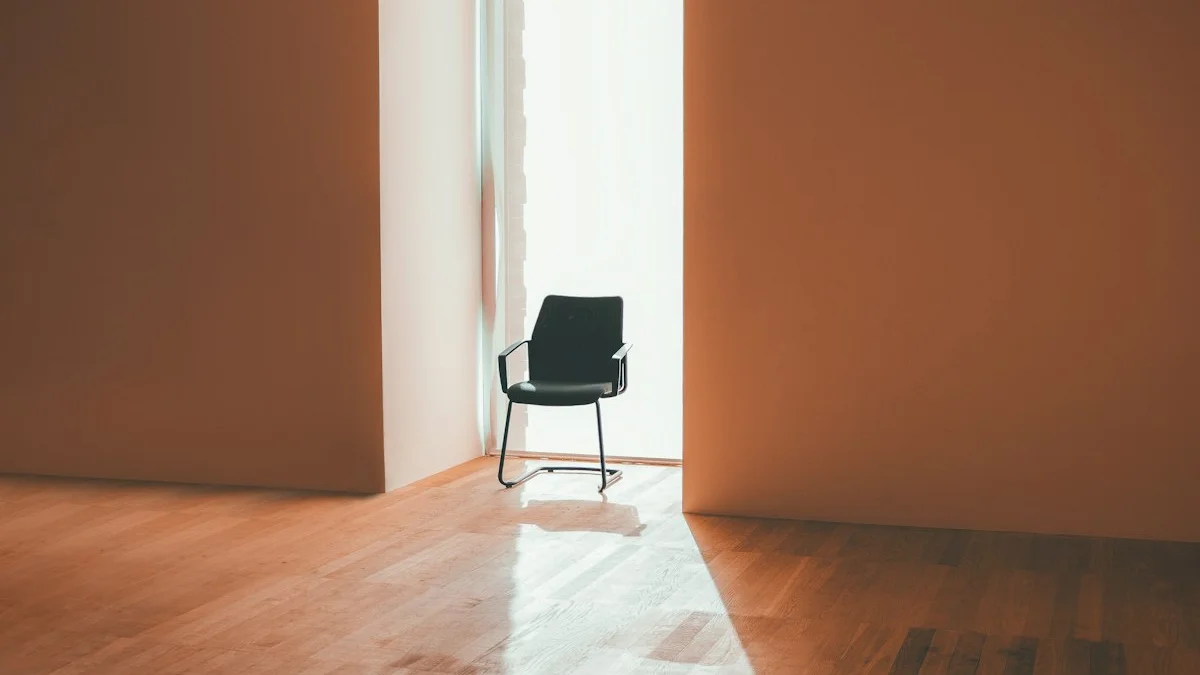
It is 5:50 in the morning and the house is not yours yet. The kettle has not spoken, the phone has not lied to anyone, and in forty minutes the day will arrive with its demands already drafted. What fills that gap is a sequence of minutes, but what makes the sequence work is smaller than that: a ritual setup of three objects and one fixed hour, arranged so that the half-asleep version of you has nothing to decide. The schedule those objects serve is laid out in the daily ritual guide.
Key takeaways
- The protocol needs four things: thirty-five minutes, a closed door, a chair that is not the bed, and a cheap notebook.
- A kitchen chair outperforms a throne, because the body has to keep the seat and the sleep separate.
- The door is not silence; it is exclusion, the circuit’s first hinge.
- Handwriting is the Receiver’s signature, which is why the log is paper and never an app.
- The Field compounds what repeats at the same address, so the same objects at the same hour do part of the work.
Why the ritual setup is part of the work
The protocol is not a state of mind. “The laws informed you. The Protocol performs you.” Reading about repetition changed nothing in the Architecture; what the Field matches is a repeated Signal, and a repeated Signal requires a repeated act - “Thirty-five minutes total: twenty-five in the morning, ten in the evening.” A repeated act needs a stage. The three objects below are not decoration and not discipline for its own sake; they are how the body is taught the difference between practice and mere sitting, and each one carries a lesson the Receiver obeys.
The chair: one seat, one address
The rule about furniture is really a rule about postures: “Practice conducted in bed teaches the deep mind that practice is a variety of dreaming, and the Receiver will obey the lesson.” The seat and the sleep have to stay separate, which is why a kitchen chair is prescribed and a throne is not: “A kitchen chair outperforms a throne.” The austerity is the point - the chair is not there to be comfortable; it is there to be consistent. “Use one chair, the same one, and let it become an address the Signal recognizes.”
Consistency does something no novelty can: it builds a groove. By the third day the arrangement starts working on you before you decide anything - “The chair acquires gravity.” You sit and the descent begins without being summoned. That gravity is earned one identical sitting at a time, and it cannot be transferred to a different chair in a different room each morning.
The door: exclusion, not silence
The second object is a boundary. The instruction is easy to misread as a demand for quiet, and it is not: “Not silence; exclusion.” A quiet room with an open circuit still leaks; a noisy household behind a closed door does not, because the door is a decision made visible. “The door is the circuit’s first hinge.”
If the household cannot be excluded - small children, a shared room, a shift that ends into a full house - the doctrine does not fold. “If the household cannot be excluded, exclude the world with headphones and a turned wall.” The principle scales down to any life: what matters is that the body knows practice has a perimeter, and that for these minutes the world queues outside it.
The notebook: cheap paper, honest ink
The third object is the record, and its material is not negotiable: “Handwriting is the Receiver’s signature. A log typed at speed is correspondence; a log written by hand is testimony.” An app is faster, searchable, and backed up, and all of that is why it fails - the protocol is performed by a body, and the body needs a body’s evidence. The notebook is deliberately cheap, because this is labor, not devotion, and the record has to be humble enough to stay honest.
Twenty-one days in, the logbook begins to pay in a currency no application carries: “the handwriting of a man who no longer exists.” You read your own state sentences from three weeks back and meet the person who feared what you have since walked through. What goes in the notebook, and the four lines a day it holds, is described in the ritual logbook and its four lines.
The hour that turns objects into a practice
Objects gather meaning from repetition, and repetition needs an address in time. “The Field compounds what repeats at the same address.” Seven days at a fixed 6:00 outweigh thirty days at whenever-you-get-around-to-it, because the fixed hour is itself part of the address the Signal learns to recognize. The chair, the door, and the notebook are the coordinates; the hour is the appointment that makes them a habit instead of a display.
There is also a quieter reason to keep the objects. The work is kept by being in the seat, not by wanting to be in it: “The Key is not kept by feeling like it. It is kept by being in the chair.” On the days the feeling is absent - and those days exist in every first month - the setup carries you: the chair is where you go, the door is what you close, the notebook is what you open.
The objects also earn their keep on the days the practice is barely kept at all. A broken morning - travel, illness, a house in chaos - still has a chair to sit on and a line to write, and the setup is the floor that holds on those days. The full sequence is the luxury of ordinary mornings; the objects are never skipped, only shortened. The full sequence those objects frame is assembled step by step in the daily ritual protocol, and the same-hour principle in the fixed hour and why it compounds. A printable version of the morning sequence lives in the free toolkit.
Frequently asked questions
Does the chair have to be a kitchen chair
No. The prescription is a chair that is not the bed, used consistently. A kitchen chair is named because it is ordinary and always available; any stable chair works if it is the same chair each day, in the same place.
What if I cannot close a door where I live
Exclude instead of silencing: headphones and a turned wall, or a chair facing away from the household. The perimeter is what the body needs to register, and it can be built in a shared room.
Why not just keep the log in an app
Because the record is evidence for a body, not data for a device. Handwriting is slower, and the slowness is the signature; a typed log is correspondence, while a written one is testimony. The app also puts the screen - the day’s first author - inside the perimeter.
Can I move the setup between rooms
You can, and it costs you. The chair becomes an address the Signal recognizes partly through location; a roaming setup restarts that learning. If a room has to change, change it once and let the new address settle.
How long before the setup feels natural
Most practitioners report the chair acquiring gravity around Day 3, and the objects feeling like furniture rather than props within the first weeks. Your own version of the curve will show up in the log.
This guide is educational and spiritual in nature. It is not medical, legal, or financial advice. If a practice brings up distress, speak with a qualified professional.
Three objects and one hour - the setup asks for less than almost any practice you have ever considered, and it asks for the same things every day. The book that names the protocol after itself, and explains why the objects do doctrinal work, is The Obsidian Key.