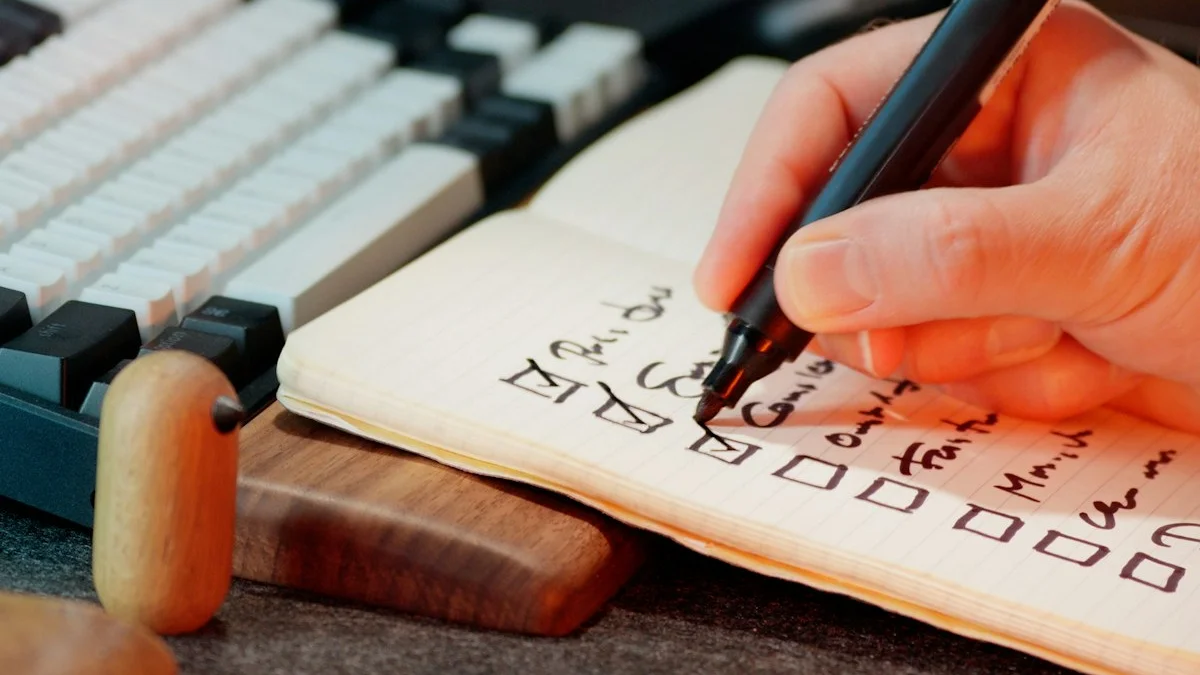
Eleven at night. The day is dissolving, and your phone has already drafted its report: screen time, pickups, one app highlighted in red. You keep logs you never chose to keep, and they audit you without mercy. Tonight consider one line you choose yourself, two minutes, written by hand, for an audience of one. That is the nightly log practice, the third and shortest step of the evening work in the guide to evening rituals, and it is the piece most likely to survive a real life.
Key takeaways
- One line, two minutes: kept or broken, morning or missed, and the initials of your state sentence.
- Truth is the only entry requirement, and ugly entries feed the compound more than pretty ones.
- The log is the third step of the ten minute evening sequence and works on nights you skip the rest.
- A missed night means resume, never restart: day eight, not day one forever.
- On broken days, ninety seconds of nine breaths plus the line is the entire practice.
What the nightly log practice asks of you
The evening sequence of the Key runs in three steps: the replay, the sealing statement, and the log. The last one is the smallest and the most often skipped, which is strange, because it is the one that turns the other two into a chain. The book gives it two minutes and a format.
“One line in the logbook: kept or broken, morning or missed, and the state sentence’s initials. Write the truth, especially when the truth is ugly.”
That is the whole ceremony. The same notebook as the replay, the same chair if you have one, one line, lights still low. If the full sequence is new to you, the ten minute evening ritual walks the three steps in order. On nights when the sequence collapses, the log is the part that stays.
The three fields of the line
Each field is a question you already know how to answer honestly, which is the only skill the practice requires.
| Field | Question it answers | An honest entry |
|---|---|---|
| kept or broken | did I keep the practice today | kept, barely |
| morning or missed | did the morning work happen | missed |
| state initials | which identity am I rehearsing | T.M.C. |
Kept means the day’s practice held; broken means the day leaked through and you know exactly where. Morning or missed records whether the morning’s work happened, without commentary on why not. The state initials are your assumption sentence, the I am the man who line, reduced to letters so the notebook stays private even if it is read. Three fields, one line, no essay. A log that grows into a diary stops being a log.
Why the truth beats a pretty line
The instruction to write the truth is not a flourish about honesty as a virtue. It is engineering. The log is the place where the practitioner and the day meet without a lawyer present, and a falsified entry defeats its own purpose, because the compound the practice builds runs on accurate material.
“A broken day honestly logged feeds the compound more than a perfect day invented.”
Read that twice if you have ever abandoned a notebook after a bad week. The perfection was the problem. An invented line teaches the instrument to perform; an ugly line teaches it to see. The log is a mirror with a date on it, and mirrors are useless when they flatter. Nothing in the practice asks you to fix what you write down. Seeing it is the work of tonight; the seeing compounds.
Resume, never restart
Sooner or later a night gets missed, and what happens in the following hour decides the fate of the practice more than any single entry. The book’s rule is two words long and worth framing.
“A man who misses Tuesday and resumes Wednesday is on his eighth day. A man who misses Tuesday and restarts is on his first day forever.”
Shame is the engine of restarting. The missed night gets read as a verdict, the notebook gets experienced as an accusation, and day one begins again with fresh enthusiasm that lasts exactly as long as the enthusiasm of last time. Resuming skips the trial. The chain holds at eight days because you say it holds, and the compound, which demands return rather than perfection, keeps the tally itself. How evenings recover without shame takes that skill further, and the same rule runs on the morning side in the morning journal’s compound mark.
The ninety second minimum on broken days
The practice also has a floor, for the nights when a full rite is fantasy: sick, shell-shocked, standing in an airport, or holding a tearful child. The book keeps even the worst days inside the practice rather than outside it.
“On broken days, the minimum viable practice: nine breaths and the log. Ninety seconds.”
Nine breaths keep the Receiver regulated. The line keeps the chain unbroken in the only place it can be kept, which is the record. Two minutes become ninety seconds and the practice survives, which is the entire secret of every durable discipline. Why bad days give the replay its best footage explains what to do with those nights when there is a little more in the tank. The breathing base and a printable log page live on the free toolkit page.
Frequently asked questions
What do I write in the nightly log
One line with three fields: whether the day was kept or broken, whether the morning work happened or was missed, and the initials of your state sentence. Write the truth about all three, especially when the truth is unflattering, and stop at one line.
What does kept or broken mean
Kept means the day’s practice held, whatever the day contained. Broken means it did not, and the honest version of that entry is more useful than a generous one. The field records the day as it was, not as it was intended, which is what makes the record trustworthy.
Is the nightly log the same as journaling
No. A journal processes; a log records. The nightly log practice has three fixed fields and a two minute ceiling, and it deliberately avoids narrative, analysis, and plans. The processing, such as it is, belongs to the replay earlier in the sequence, and the log closes the evening rather than reopening it.
What if I miss a whole week
Resume rather than restart, and let the first line back be honest about the gap. The rule of the eighth day applies at any scale: the chain continues from where it actually is, not from where you wish it were. A week of blanks noted truthfully feeds the compound more than a fresh notebook that pretends nothing happened.
Does the log need a special notebook
No. The same cheap notebook as the rest of the evening work is ideal, because one object carrying the whole sequence is easier to reach for. What matters is the pen, the two minutes, and the truth, none of which are sold separately.
One line, and the chain it keeps
Two minutes, three fields, and a rule about return: the nightly log is the smallest practice in the Key and the one that holds the others together. Start tonight with a single line, kept or broken, and let the record be true. The full evening protocol it belongs to, replay and sealing included, is laid out in The Obsidian Key.
This guide is educational and spiritual in nature. It is not medical, legal, or financial advice. If a practice brings up distress, speak with a qualified professional.